
Navpad Oli – (Nine Elements)
(Also Called Ayambil Oli)
It is exactly between Shukla Saptami (Seventh lunar day) to Purnima (Full moon day) in both Ashwina and Chaitra months. Navpad Oli starts in the middle of the Navratri festival.
Together with the three Chaturmasik Atthai (monsoon eight-day observances) observed during the year, the two annual Navpad Oli observances make up the five Shashwata Atthai (perpetual eight-day observances) in Jain tradition.
During the nine days, practitioners observe Ayambil Tapa (austerity/fasting) to honor the nine supreme elements (padas) in the universe. Ayambil (Ayambila) is a strict fast in which only plain boiled grains are eaten once a day, with nothing added, including no salt, sugar, or oil, making it challenging for laypeople to observe.
Rooted in the time of the 20th Tirthankara, Munisuvrat Swami (roughly 1.1 million years ago), when Mayanasundari brought her husband King Shripal and 700 others afflicted with leprosy to monk Munishchandra, who instructed them in the nine-day Oli fast and Siddhachakra Mahapuja that restored their health.
The Nine Days of Navpad Oli
Guru Tatva
Day 1 — ARIHANT PAD
Arihant - the one who has conquered inner enemies such as anger, greed, ego, and deceit.
The Arihant is the supreme power of nature and the purest soul in the universe with a physical body. "Ari" means enemy and "hant" means destroyer. Here, the enemies are internal—specifically Raga (craving or attachment) and Dvesha (hatred). Placed at the center of the Siddhachakra Yantra and free from earthly attachments and hatred, the Arihant is known as Veetraga (one free from attachment and hatred), living in the world with a physical body in perfect equilibrium while serving as a universal observer with complete wisdom (Kevala Jnana, or omniscience).
The Arihant possesses 12 attributes and is symbolized by white. Day 1 is observed on Shukla Saptami (seventh lunar day of the bright fortnight) with Ayambil using boiled rice to match the white color of this pad, as practitioners spend the day in prayer, worship, and meditation.
Day 2 — SIDDHA PAD
Liberated Soul — Deva Tatva (posted at the top of the Siddhachakra Yantra)
This is the second pad (position or station) of Navpad, positioned at the top of the Siddhachakra Yantra and counted among the Deva Tattva Deva Tattva (divine/supreme reality category). The Siddha is the supreme power of nature and the purest soul in the universe without a physical body. A soul becomes a Siddha upon attaining salvation. Like the Arihant, a Siddha is a Veetraga and a universal observer, but does not preach because they have no physical body—abiding instead in perfect equilibrium, eternal peace and joy, and motionless rest.
The Siddha possesses 8 attributes and is symbolized by red. Day 2 is observed on Shukla Ashtami (eighth lunar day of the bright fortnight) with Ayambil using boiled masoor (red lentils) or wheat.
Day 3 — ACHARYA PAD
Spiritual Master — First among Guru Tattva
This is the third pad of Navpad, placed to the right of the Arihant in the Siddhachakra Yantra and first among the Guru Tattva (spiritual preceptor category). The Acharya is the successor to the Arihant and leader of the four-fold Sangh, holding supreme decision-making authority in all Sangh matters and serving as the ultimate authority in interpreting the Jain Agams (Holy Scriptures).
The Acharya observes and guides monks and nuns in five spiritual conducts (Iryanachara, Darshanachara, Charitrachara, Tapachara, and Veeryachara), possesses 36 attributes, and is symbolized by golden yellow. Day 3 is observed on Shukla Navami (ninth lunar day of the bright fortnight) with Ayambil using boiled chana (chickpeas).
Day 4 — UPADHYAYA PAD
Spiritual Teacher — Second among Guru Tattva
This is the fourth pad of Navpad, placed below the Arihant in the Siddhachakra Yantra and second among the Guru Tattva. The Upadhyaya has mastered the Jain Agams, eleven Angas (canonical scriptural texts), and fourteen Purvas (ancient foundational texts), and is responsible for academic instruction and teaching Sadhus (monks) and Sadhvis (nuns) within the Sangh.
The Upadhyaya possesses 25 attributes and is symbolized by green. Day 4 is observed on Shukla Dashami (tenth lunar day of the bright fortnight) with Ayambil using boiled moong (green gram) to match the green color of this pad.
Day 5 — SADHU PAD
Monk / Ascetic — Third among Guru Tattva
This is the fifth pad of Navpad, placed to the left of the Arihant in the Siddhachakra Yantra and third among the Guru Tattva. A Sadhu renounces household life to follow the five supreme vows (non-violence, truth, non-stealing, celibacy, and non-possession), walking barefoot without vehicles, money, or possessions.
The Sadhu embodies 27 attributes and is symbolized by black. Day 5 is observed on Shukla Ekadashi (eleventh lunar day of the bright fortnight) with Ayambil using boiled urad (black gram).
Dharma Tatva — The Three Gems
Day 6 — SAMYAG DARSHAN
Right Faith — First of the Three Gems
This is the sixth pad of Navpad, representing Samyag Darshan (right faith or true vision in the nature of reality) in the Siddhachakra Yantra. Samyag Darshan is unshakable confidence in the Tattvas (fundamental realities) and the teachings of the Arihants, Siddhas, Acharyas, Upadhyayas, and Sadhus, free from doubt, attachment, or superstition.
[Placeholder: Add details on attributes, associated color, lunar day, and Ayambil grain observance for this pad.]
Day 7 — SAMYAG JNANA
Right Knowledge — Second of the Three Gems
This is the seventh pad of Navpad, representing Samyag Jnana (right knowledge) in the Siddhachakra Yantra. Samyag Jnana is accurate, non-distorted understanding of reality aligned with the Agams (Jain canonical scriptures) and free from false belief or misinterpretation.
Samyag Jnana is symbolized by white and observed on Shukla Trayodashi (thirteenth lunar day of the bright fortnight).
Day 8 — SAMYAG CHARITRA
Right Conduct — Third of the Three Gems
This is the eighth pad of Navpad, representing Samyag Charitra (right conduct). Samyag Charitra means aligning one's actions, speech, and restraint with right faith and right knowledge in accordance with the Agams
Samyag Charitra Pad is associated with the color white and observed on Shukla Chaturdashi (fourteenth lunar day of the bright fortnight).
Day 9 — SAMYAG TAPA
Right Austerities
This is the ninth pad of Navpad, representing Samyag Tap (right austerity or disciplined penance). Samyag Tap is the practice of outer and inner restraint—such as fasting, contentment, modesty, and meditation—performed with right attitude and without ego or attachment to purify karma (spiritual cause-and-effect).
Samyag Tap Pad is associated with the color white and observed on Chaitra Purnima (full moon day of the bright fortnight).
Observance Guidelines (If Full Ayambil Is Not Possible)
If performing full Ayambil for all nine days is not feasible, the following alternatives are encouraged:
- Avoid eating root vegetables during all 9 days.
- Observe Chauvihar (no food or water after sunset) on as many days as possible, or at least over the weekend.
- Perform Logassa Khamasana and Navkarvali on as many days as possible, or at least over the weekend.
- Observe Ayambil for at least one day or as many days as manageable, alongside maximum possible Aradhana (devotional practice).
Science of Navpad & The Siddhachakra Yantra
Seasonal & Spiritual Balance
Chaitra (March/April, transition from winter to summer) and Ashwina (September/October, transition from summer to winter) mark equinox-like periods when day and night are nearly equal and nature is in moderate balance — ideal for spiritual focus, mental calm through prayer, physical detoxification through plain boiled Ayambil meals, and reducing one's environmental footprint.
The Complete Tap Cycle
Completing the twice-yearly nine-day Ayambil Oli for 4.5 consecutive years (81 total days) fulfills a complete Navpad Oli Tap cycle. The practice is considered Shashwati — eternal across past, present, and future time cycles.
Siddhachakra Yantra — The Wheel of Perfection
"Siddha" means liberated soul, "Chakra" means freedom from karmic bondage, and "Yantra" means mystical diagram. In worship, the first five posts (Panch Parmeshthi) are typically represented as idols while the remaining four are represented by name.
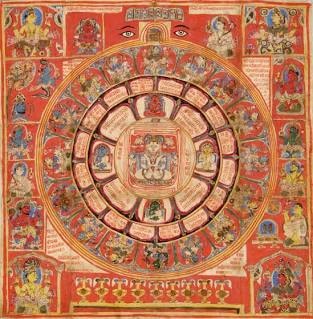
| # | Position in Mandala | Element |
|---|---|---|
| 1 | Center | Arihant |
| 2 | Top | Siddha |
| 3 | Right of Arihant | Acharya |
| 4 | Below Arihant | Upadhyaya |
| 5 | Left of Arihant | Sadhu |
| 6 | Between Siddha and Acharya | Faith (Samyag Darshan) |
| 7 | Between Acharya and Upadhyaya | Knowledge (Samyag Jnana) |
| 8 | Between Upadhyaya and Sadhu | Conduct (Samyag Charitra) |
| 9 | Between Sadhu and Siddha | Penance & Forbearance (Samyag Tapa) |
Historical Background & References
The earliest known Prakrit text of the story was composed by Acharya Ratnashekharsuri in 1372 AD (who is also credited with the oldest current Siddhachakra Puja), while the widely known Gujarati version was composed by monks Vinayvijay and Yashovijay in 1682 AD (Shripal Raja no Ras).